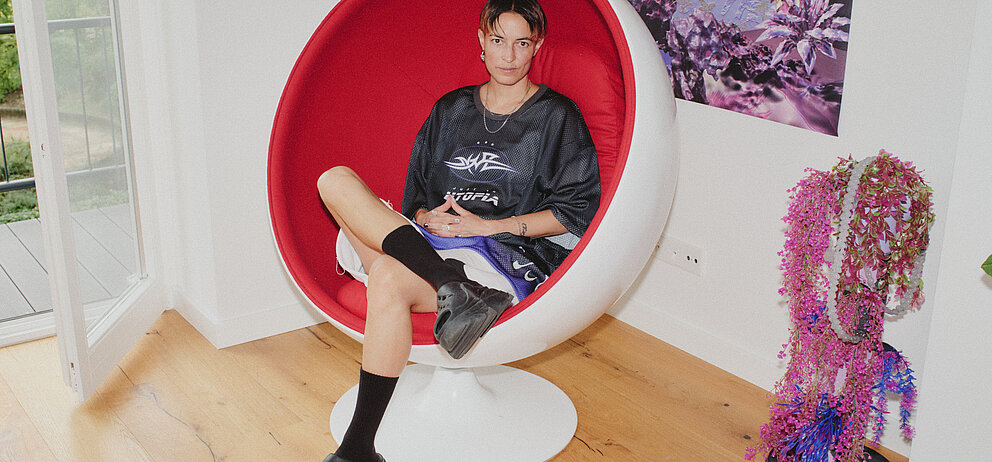
Anan Fries
Buried deep beneath the gleaming plastic cases and reflective screens of contemporary technologies lies what Anan Fries calls the “TF spectrum”: a vast, ramified field between tech-feminism and tech-fascism, within whose densely layered strata contradictory fantasies, ideologies and visions of the future emerge from the very same conditions. Concepts of queer pregnancies and new forms of kinship intertwine here with eugenic dreams of control and optimisation. Emancipation and surveillance share the same infrastructures and interfaces, and at times even the same user-friendly aesthetic. In performances, games and hybrid stage worlds, Fries delves deep into this contradictory terrain and uncovers speculative scenarios in which technological utopias shape bodies, organise desire and give rise to their own myths.
Anan Fries works across disciplines between Berlin and Basel and has long been engaged with the art of world-building. After many years in the independent performing arts scene, as a founding member of the theatre-game collective machina eX – with whom HAU has been collaborating since 2011, and the queer-feminist performance collective Henrike Iglesias – Fries has developed a dramaturgical language in which the invisible logics of digital environments are transposed onto bodies, spaces and movements. In “Virtual Wombs” (2021, HAU, in collaboration with Malu Peeters), Fries guides the audience through the body of a pregnant post-human, in which VR, live performance and speculative world-building conjure up new images of pregnancy and non-normative reproduction. The body thus becomes the setting for technological fantasies about how alternative forms of kinship might re-materialise the future. “ “R.I.P. – Resurrect in Peace II” (2024, HAU) uses live tracking to translate a burial ritual for an extinct bird species into a digital ecosystem in which physical presence, simulation and speculative narratives overlap. Fries’ stages are populated by the ghosts of our technologised world and, at the same time, constructed from its tools.
“LORECORE” (2026, HAU) delves even deeper into the dark catacombs of Silicon Valley. An avatar roams the gloomy corridors of a medieval dungeon, whilst three performers are trapped in the endless loops of viral TikTok dances. The great myths of the tech industry appear like artefacts from a forgotten civilisation: heroic founders, technological marvels, visions of an impending apocalypse. Live gaming, repetitive choreography and video essays coalesce into a stage that increasingly follows the logic of an algorithmic feed, in which political prophecies circulate alongside cat videos and the narratives of Big Tech. Like the lore of a game, which only reveals itself through scattered artefacts as one explores, a reality takes shape here that is constantly rewriting its own origin story.
In “PURGR” (2026), a collective purification ritual for impure smartphones, technical devices become cult objects. The work was part of “New Rituals [for the End of the World]” (HEK Basel), an exhibition curated by Fries in collaboration with Marlene Wenger on ritual practices emerging under the conditions of contemporary challenges. According to Fries, the desire for spirituality stems precisely from the absence of a truly convincing faith, in the face of a world in which machines have long since been generating their own rituals.
Between stage and screen, Fries lays bare these contradictory layers one by one, revealing the TF spectrum as a sediment of our time: ideologically charged, highly mediatised and deeply embedded in our everyday gestures.
Sophie Publig
Past
